Wednesday, November 28, 2007

Sonoran Rhythms

I am back from my Thanksgiving journey in the far West and man, that was really awesome. Far away from cities during those rush hours of Black Friday and far away from crowded stores, I was wandering around in the Sonoran Desert in search of quietness and relaxation.
.
And that is exactly what I got : miles and miles of trecking in the wilderness along deserted tracks and miles and miles of driving along secondary roads into uninhabited areas where services are scarse and traffic barely existant. But most of all, I came back with a plethora of pristine landscape memories that will stay forever in my mind.

A road-trip along the Mexican border in the Sonoran wilderness


  • Wednesday

Early in the morning, I flew from Atlanta to Phoenix aboard a Delta Airlines Boeing 767-300 jet. I then headed to Tucson to explore the Southern part of Arizona and the Sonoran desert.

.

With architectural landmarks such as this one, Tucson is undoubtedly an old city from the South West.
.
White roman-catholic cathedrals remind the traveller of the Spanish and Mexican history of this part of the United States.
.
Incidentally, Spanish and English are both official languages in Arizona.
.
Saint Augustine Cathedral in Tucson

.


  • Thursday

Thursday clinged as the beginning of the exploration. Surrounded to the West and to the East by Saguaro National Park, a traveller getting out of Tucson cannot miss the huge and unmistakable shapes of giant Saguaros.

Saguaro and Choilla cacti in the Eastern part of the park


The giant saguaro is the largest of all cacti found in the United States and has thus become an iconic representant of the Grand Canyon state.

The Saguaro -Carnegiea gigantea- pronounced sah-wah-roh is a tree-sized cactus commonly found in South Arizona.
.
Reaching up to six meters, they outlive human beings as they may grow for up to two hundred years. Their body is composed of wooden ribs holding water and surrounded by a thick skin covered with spikes to protect the cactus against predators and to limit water evaporation.


A giant 200-years old Saguaro next to a tiny bush of Pricky Pear Cacti


.
.
The skin is pleated so that the cactus may contract itself during periods of drought and may dilate itself to accomodate more water after Winter rainfalls or Summer thunderstorms. The largest saguaro can hold up to eight tons of water.

Saguaros produce a flower and a sweety fruit that is pollinized by bats and that can be eaten. Native Americans used to collect them to prepare their own food.

Fascinated by this giant cactus, Native Americans were treating Saguaros as living creatures.
.


Respect the Giant Saguaro for it is your brother...

.


The journey to the South brings me to highlands and plateaus reaching up to 4,000 feets. Temperatures are cooler and water is more abundant permitting more complex and denser forms of vegetation.

An overwhelming silence surrounds the highlands West of Tombstone


The next stop was Tombstone, Arizona where one of the most famous gunfight occured on October of 1881. In this place that would later symbolize the struggle between law-and-order and rustling in frontier towns of the West, the Earp and the Clanton factions met to settle one of the west most famous feud.
Burt Lancaster
Kirk Douglas
(1957)
.

OK Corral, OK Corral...
There the outlaw band
Made their final stand.
OK Corral...

Oh my dearest one, must I
Lay down my gun?
Or take the chance
Of losing you forever?

Duty calls
My back's against the wall.
Have you no kind word to say
Before I ride away? Away...

Your love, your love,
I need , your love...
Keep the flame, let it burn
Untill I return
From the Gunfight at OK Corral.
.
If the Lord is my friend
We'll meet at the end
Of the Gunfight at OK Corral.
Gunfight at OK Corral.


.
..
Boot Hill
Boot Hill
So cold
So still
.
There they lay side by side
The killers that died
In the gunfight at OK Corral
OK Corral
.
Gunfight at OK Corral
.
.
  • Friday
Friday started my skimming along the Mexican border. From Tucson to Yuma through Aro, Kitt Peaks and Organ Pipes National Park. The journey consisted of almost three hundred miles through the great Sonoran desert. Midway between Tucson and Yuma, I stopped on top of the 7000ft-high Kitt Peak to visit some observatories. There was several telescopes there but in the lot stand the rather unusual McMath-Pierce solar telescope featuring an heliostat. Interesting it was...
.
Desolated landscapes in the Organ Pipes Natural Park. A United Nation international Biosphere Reserve. Life is scarce during the day when temperatures reach up to 40°C.


The cactus on the left is the so-called Organ Pipe Cactus. Organ Pipe cacti require sunlight and high temperatures to grow and flourish.

Only low elevations such as those found around Organ Pipes National Park and Baja California in Mexico are suitable for this kind of species.

Organ pipes in the last sunrays of the day


The next step of the journey consisted of driving further West to Yuma on the banks of the Colorado river right on the Arizona and California border. While entering California, some forms of human civilisation start to show up again. The most obvious one is traffic both on roads and railtracks. Railtracks... Speaking of railtracks, when I was a little kid, I used to count with my brothers the number of cars on those endless American trains. I think we found some in California that were fifty-car long.
.
.

Yuma is another symbol of the American Far West with the famous 3:10 to Yuma movie taking place there. .
.


(1957)
Glenn Ford
Van Heflin
.


There is a lonely train,
Called the 3:10 to Yuma.
The pounding of the wheels,
Is more like a mournful sigh.

There's a legend a
nd there's a rumor,
When you take the 3:10 to Yuma,
You can see the ghosts,
Of outlaws go riding by.

In the sky, w
ay up high,
Tthe buzzards keep circling the train.
While below,
The cattle are thirsting for rain.
It's also true, they say,
On the 3:10 to Yuma,
A man may meet his fate,
For fate travels everywhere.

Though you've got no reason to go there,
And there ain't a soul that you know there,
When the 3:10 to Yuma whistles its sad refrain,

Take that train! Take that train!

Well, as far as I am concerned... I wouldn't ride on that train....


  • Saturday

Saturday started the beginning of my Californian adventure. From Yuma, I headed to the Imperial Sand Dunes and later to Calexico, one of those twin-cities along the Mexican border: Calexico in California and Mexicali in Mexico.

There is a little bit of Sahara in this picture. Don't ask me why...
.
Later in the day, I headed North to Salton Sea, Indio and Mount Palomar. For me, it was a trip back in time and in my very own footsteps which brought back fond memories of childhood. I went there in 1991 and I still think of it as if it were yesterday. I remember playing and splashing all around while swimming with my huge inflatable hippo in Salton Sea. It was 16 years ago ... I'm getting old I guess.
.

Mount Palomar Hale telescope. The 200-inch telescope features adaptative optics and remained the world largest telescope for 45 years between 1948 and 1993.

Mount Palomar observatory stands high on the Coastal Range at 5550 feet above the Pacific. Operated by the California Institute of Technology (those lucky bas....!), it is one of the first modern Cassegrain telescope. However, even at that altitude the ever-growing light polution from public lighting in San Diego and Southern California dooms the future of this otherwise great facility.

.

  • Sunday

Sunday was my second day in California. Starting my journey in cosy Palm Springs in the Coachella Valley, I drove East to Joshua Tree National Park. Coachella Valley lies at the junction between the Northwest-moving Pacific Plate and the North American Plate. With the two plates rubbing each other, it is therefore a place of large sismic activity.

Lying in the middle of the Coachella Valley, the San Andreas fault reminds us that California is one of the most Earthquake-prone place on Earth


Here is the so called Joshua Tree - Yucca Brevifolia. Joshua Trees are very common in the elevated Mojave desert of Utah and Nevada. Joshua Tree National Park lies on the Southern edge of its natural geographical spread and marks the northern border of the Sonoran desert.

The name Joshua tree was given by a group of Latter Day Saints who crossed the Mojave Desert in the mid-19th century. The tree's unique shape reminded them of a Biblical story in which Joshua reaches his hands up to the sky to stop the sun by God's command.
.


A Joshua Tree in all its glory


The tips of Joshua Trees and their flower remind observers that this is indeed a Yucca.
.
Granite outcrop formations are the signature of Joshua Tree National Park. Formed in deep intrusions, these rocks underly most of California's mountain ranges from the Sierra Nevada to the Mexican border. Because it cools slowly, its minerals grow into large, tightly locked grains. This is the medium in which weathering and erosion of various kinds have sculpted Joshua Tree's remarkable landforms.

A skull seems to emerge amongst granite boulders
.
  • Monday

Monday consisted of crossing the Colorado river and driving back to Phoenix. I stayed only a couple of hours in Phoenix while awaiting my flight back to Atlanta. Boarded the Boeing 757-200 very early Tuesday morning to get back in town Tuesday by 6am.

The Colorado river in an oasis of life lost amongst hundreds of square miles of arid and unforgiving landscapes

A video of this journey is available here. Enjoy !!

.

Monday, November 19, 2007

Cross country to North Carolina

I haven't posted for a while, not because of lack of time but because of lazyness I guess. So I thought a little update about what I was going through would be welcomed... Well, last week-end was pretty fantastic, the highlight being a very nice flight to North Carolina.
.
There are several milestones attached to this flight so you can expect a pretty comprehensive story about it... I am nevertheless awaiting the pictures from my friend to post a complete report. In the meantime, you will have to help yourself with this little petty appetizer...
.
So I flew with a good friend of mine deep into the Great Smoky Mountains up to Bryson City and Franklin in North Carolina. In Bryson City, we skimmed along the Tennessee borderline before heading back South again to Franklin. Up there, we enjoyed an awesome view over the Appalachians : miles and miles of endless and uninhabited mountains reching more than 6,000ft. I was expecting a bumpy ride over those peaks but at 7,500ft turbulence was allright. Choppy from times to times but nothing major. The crystal clear weather above a thin layer of haze as well as the late evening sunrays added some fiery colors to an already dramatic late Fall festival of red and orange. What a sight !!
.
As might be observed in the picture, large embankments of sand along Lake Fontana are clear indicators of the worst drought in decades that the South East is experiencing. According to the media, there are only sixty-days of water left in Lake Lanier, the major water reservoir supplying Atlanta... Well... well... well...


After almost two hours in the air, we glided peacefully towards Franklin airport where we stretched our legs and enjoyed the calm and peacefull atmosphere surrounding those massive mountains. We took the opportunity to refuel both the aircraft and our bellies for the late afternoon and early dusk trip back home.

This is bitsy birdy, the little Cessna C172 that hauled both of us during the entire trip. Seen here cooling down and resting on the ramp while awaiting us to return to its home base in Atlanta. The sunshine nearly transformed the ramp into a bright sea of silver...
.
That's it for today...as soon as I get new pictures, I will update the thread.
.

Sunday, November 11, 2007

Cleared my Quals

Done.
I still can't believe it but I am done. I guess I am off for at least six months of celebration, dancing, flying and travelling. Yeah, I believe I will need at least six months to go back to my studies...
I left so much behind me to come here and do this PhD, I couldn't afford to miss the step. Too much left and lost forever, it couldn't be for nothing.

Tuesday, October 23, 2007

Speaking of dancefloors

Speaking about dancefloors, let me announce the next Ballroom Dance Club party which will be held on Saturday, November 3rd. There is no need to know dancing as there will be a free Hustle lesson at 9pm. There is also no need to come with a partner since there will be plenty there.
.
I think this is one of the nicest flyer I have ever done...
I am proud of myself...
:-)

Monday, October 22, 2007

Confession not on a dancefloor...

All right, for once I will uncover myself. Yeah, you heard correctly...

I am scared. Scared about those Qualifyers. Guess I started too late due to devoting too much of my time to the research until October. But October was already late and now I am running late, real late.

I guess I am as scared as I was a few several years ago on the night before the first examinations for Mines - Ponts.

But well...life is great... that's what people say. Who am I to disagree ?

Friday, October 19, 2007

Flying On Top

Well today is Friday so I guess you already know what I did... As my advisor uses to say, there is no better place to be on a Friday morning than inside a cockpit and at the controls... And you know what ? The weather was ugly. I keep on repeating myself here but let me state it again : the weather is always ugly in Atlanta on Friday mornings. Still, this time there was something new : besides practicing instrument approaches, I got checked out on a Piper Warrior II.
.

Here is the beast resting on the ramp at Dekalb-Peachtree Airport

.
As might be seen in this picture, the aircraft is a fixed gear and features a low-wing with dihedral. It was built in 1983 by Piper Aircraft in Vero Beach, Florida. Dubbed Piper Warrior II, it's official name is PA28-160 and the radio callsign is Cherokee. To be slightly more pedantic, it comes equipped with a 160 hp normally aspirated Lycoming engine, has an empty weight of roughly 1500 lbs and a maximum take-off weight of 2325 lbs.
.

Cockpit dashboard for the Cherokee Warrior. Flying at 100kt, climbing through 3100ft at 500ft per minute and heading to 050°
.

The dashboard features all the standard instruments you would expect in a VFR - IFR - Day - Night certified aircraft. From left to right, from up to bottom we will find a clock, an airspeed indicator, an attitude indicator, an altimeter, an ILS receiver, an ADF receiver, a turn coordinator with a ball, a heading indicator, a vertical speed indicator and a VOR receiver. In the lower part of the dashboard lay the engine and fuel indicators whereas the communication and navigation displays are on the right. This aircraft is also equipped with a LORAN receiver which is a nice and fancy addon not commonly found in Europe.
.

Just breaking out of the overcast layer of clouds.
.

I did most of my initial flight training in France in a Piper PA38-112 Tomahawk (also called Traumahawk...) but I haven't flown any Piper aircraft in the last three years. It was also a return to low-wing designs after a two-year break period. So, a return to my first love ?

Low-wing aircraft call for a slightly different technique for landings since there is a lot more ground effect and the aircraft tends to float over the runway. Therefore, to reach the pilot's holy grail of kiss-landing, subtle adjustments are required when transitionning from high wings such as Cessnas to low wings.
.

Cruising right over Atlanta sandwitched between a lower layer at 700ft and an upper layer at 10,000ft.
.

I have always liked the design of Piper cockpits. It both looks clean, neat and a bit more airline-aircraft styled. In addition, there is an excellent forward visibility. My only grief about Piper designs would be the single right cockpit door that lacks the flexibility of Cessna's.
.
5075ft, 100kt and 90° on the heading
.

On the way back to Dekalb-Peachtree airport, the weather was slightly improving and the lower layer started to fragment going from an overcast to a broken layer. During the ILS-20L approach, we broke out of the cloud at 1000ft above ground and performed a sidestep approach to runway 20 Right to pave the way for a faster flying twin Cessna behind us.

Radar track for part of the flight may be found here.

Stay tuned for some more adventures...
.

Sunday, October 14, 2007

Plane Spotting in Philadelphia

Here is a short summary of my wandering for almost fourteen hours in the concourse A of Philadelphia's airport. The international pier is sure very interesting during the late afternoon when it comes to life with transatlantic departures to Europe all over the place. Taking advantage of that, I shoot some pictures of each and every model of US Airways long-haul fleet.
.
Boeing 757-200
The Boeing 757 is the smallest aircraft used by US Airways for its long-haul operations. The one depicted below is quite special as it has been tailored for Transatlantic operations. It has been certified under the Extended-range Twin-engine Operational Performance Standard and comes under the designation of B757-200ET to allow for operations above oceans far away from diversion airports. This is a mandatory requirement as long as flights are more than sixty minutes away from any usable airport.

Dark picture but with thunderstorms all around, skies were dark


ETOPS certification makes things a lot easier for airlines operating over the North Atlantic as diversion airports are few and far in between. Once over the Atlantic, the closest airports are Hamilton in Bermuda, Narsarsuaq in Greeland, Keflavik in Iceland and Lajes in the Azores.

Wingletted 757 plugged on an auxiliary air conditionning system


The other thing that makes this Boeing 757 special is the installation of blended winglets designed by Aviation Partners. The 757 is capable of crossing the Atlantic range-wise but not by a very large margin. This is why airlines mostly use the 757 between the North-East coast of the US and North-West Europe. However, in order to account for strong jetstreams during the Winter and to operate the aircraft further inside Europe, airlines have added winglets that slightly improve fuel consumption and range for long operations.

Boeing 767-200
I was pretty happy to find a load of Boeing 767-200 at Philadelphia as these aircraft are slowly being retired and therefore are more and more difficult to spot. Most of them have already been retired and few airlines still operate them. Continental Airlines, American Airlines and US Airways are the largest operators of the type now but they already plan to phase them out in the coming years.

Boeing 767-200 getting ready for its flight to Spain. The center wingbox fuel tank s visible at the rear of the forward hold.

The Boeing 767-200 was the first aircraft of the 767 production line in Everett, WA. However most of the 767 production consisted of the stretched 767-300 and 767-300ER. US Airways still operate the early-built 767-200ER which features a somewhat higher gross weight and most importantly more fuel capacity.

Pushed back and starting the hairdryers

This version of the 767 is the second longest-range aircraft in US Airways fleet despite serving chiefly the airline for more than fifteen years. However, at the time the airline bought the airplane, operations to Europe were not planned and the airline decided to go with a rather low maximum take-off weight - 330,000lbs - thus tremendously limiting the range-payload envelope of the aircraft. This saddly reduces the capabilities of an otherwise very capable airplane. As a result, US Airways uses them mostly to serve its high capacity routes in western Europe.

The new color scheme is both classy and very curvy


After being towed away from the international pier, this 767 starts its own General Electrics CF6-80C2 engines and is about to go on its own power for another ride above the Pond.


Airbus A330-300
The Airbus twin widebody is the largest aircraft in US Airways fleet. It is also the yougest with deliveies starting in the late 90's. The A330 is used to serve core European destinations as well as Star Alliance partners hubs. I got lucky enough to find this one in the so called old new paint scheme that will slowly disappear in time.

Unloading late passenger bags before heading to Germany
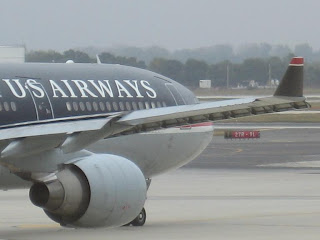
This one was aimed for Star Alliance hub in Frankfurt. It stayed for several minutes at the gate after the jetway was removed in order to unload some baggage of no-show passengers. Some people will never get it...

Starting those massive Pratt&Whitney 4128 turbofans


The airline ordered Pratt & Whitney engines for its A330 fleet which allows the airline to offer long range flights well into Europe to Athens and Rome.

Getting read for an eight hour flight over the Pond to Frankfurt am Main.

While awaiting for taxi clearance and experiencing the usual ATC delays at Philly, the aircraft starts its engines and extends the flaps and slats. Notice the ailerons tilted down and used as flaperons for take-off.

As a bonus, a pre US Airways-America West merger paint scheme on this A320. Radio callsign for America West aircraft was Cactus.
Cute?

.

That's it for a short description of US Airways long-haul fleet. By the way, did I mention that ETOPS also stands for Engines Turn Or Passenger Swim... ?
.